


17 Jun 2026
How BIM Workflows Change Between Steel and Concrete Structures?
The construction industry is rapidly shifting towards the intelligent digital workflows and BIM has become central to this transformation. From design coordination to fabrication and facility management, BIM is reshaping how the structural systems are planned and executed.
According to the recent industry reports by NBS, nearly 72% of construction professionals globally now use BIM workflows in some capacity, highlighting the growing reliance on the digital construction practices. Additionally, the studies shows that over 70% of BIM users believes that BIM improves the project safety, productivity and coordination efficiency.
However, BIM workflows are not identical across all structural materials. Steel and concrete structures requires fundamentally different modeling strategies, detailing levels, collaboration processes and fabrication approaches. Understanding these differences is critical for the architects, engineers, fabricators and contractors aiming to maximize the project efficiency.
Understanding the Core Difference
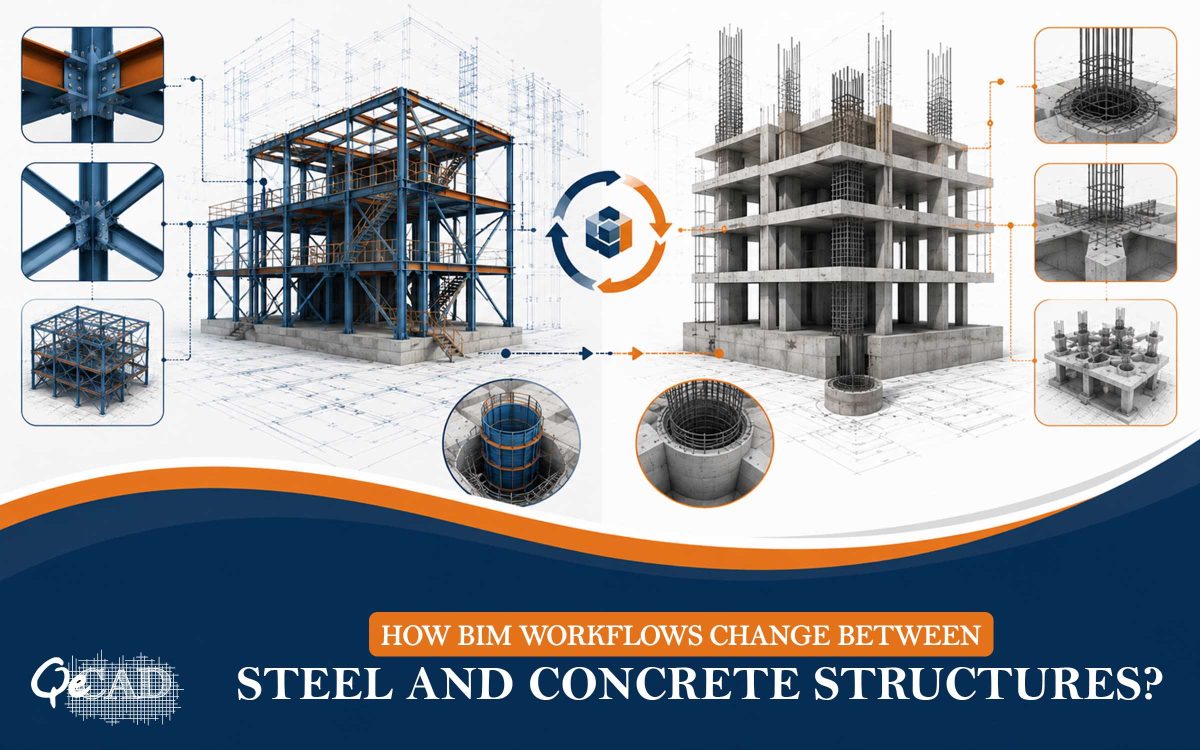
At a high level, steel BIM modeling focuses heavily on the fabrication precision and assembly sequencing, while concrete BIM modeling emphasizes reinforcement detailing, formwork coordination and construction phasing.
Steel structures are generally prefabricated off-site and assembled on-site. This requires highly accurate fabrication-level models with precise connections and tolerances.
Concrete structures, on the other hand, are often cast in place, making reinforcement coordination, pour sequencing and structural continuity the primary modeling priorities.
These differences significantly influence the BIM workflows from the design development through the construction execution.
1. Modeling Philosophy
Steel BIM Modeling
Steel structures are driven by manufacturing logic. Every beam, column, plate, bolt, weld and connection must be modeled with high accuracy because the model directly influences the fabrication and erection.
In most steel projects, BIM models are developed up to LOD 400 or even LOD 500, where every component is fabrication-ready. Industry research indicates that the Tekla Structures appears in nearly 87% of steel BIM workflows due to its strong detailing and fabrication capabilities. (MDPI)
Key priorities includes:
- Connection detailing
- Fabrication drawings
- CNC data generation
- Erection sequencing
- Clash-free coordination
- Material optimization
This is where advanced Steel Modeling Services becomes crucial in reducing fabrication errors and improving the erection efficiency.
Concrete BIM Modeling
Concrete BIM modeling is more construction-oriented than fabrication-oriented. Since the concrete is often poured on-site, the focus shifts towards:
- Reinforcement detailing
- Formwork planning
- Pour sequencing
- Structural integrity
- Rebar congestion analysis
- Construction scheduling
Concrete models requires continuous coordination between the structural, architectural and MEP disciplines because the embedded systems, sleeves and openings must be accurately placed before the pouring begins.
Unlike steel structures, concrete BIM models may not always require fabrication-level precision for every component, but they demand exceptional reinforcement coordination.
2. Level of Detail (LOD) Requirements
Steel Structures
Steel projects generally demands higher LOD earlier in the project lifecycle.
Typical progression:
- LOD 200: Conceptual framing
- LOD 300: Structural coordination
- LOD 400: Fabrication detailing
- LOD 500: As-built verification
Because steel fabrication occurs off-site, even small dimensional inaccuracies can create major erection problems on-site.
A study on structural BIM adoption found that the steel structures are among the most common applications for BIM because of their dependency on the precise fabrication workflows. (Engineering News-Record)
Concrete Structures
Concrete BIM models evolves differently.
Typical priorities:
- Reinforcement detailing
- Concrete cover requirements
- Embed placement
- Pour break identification
- Construction joint coordination
Concrete models often requires heavy reinforcement data management, especially in the infrastructures, bridges, hospitals and high-rise projects.
Complex rebar intersections can significantly increase the modeling time compared to the steel framing systems.
3. Coordination Challenges
Steel BIM Coordination
Steel coordination revolves around:
- Connection clashes
- Fabrication tolerances
- Erection access
- MEP penetration conflicts
- Structural stability during erection
Since steel elements are prefabricated, late-stage modifications becomes costly and disruptive.
BIM-based clash detection can reduce coordination issues substantially before fabrication begins, helping avoid expensive field rework.
Industry discussions among BIM professionals consistently highlight clash detection as one of BIM’s highest-value applications, particularly in steel-intensive projects.
Concrete BIM Coordination
Concrete coordination is more complex in terms of embedded systems and reinforcement density.
Major challenges includes:
- Rebar congestion
- Sleeve placement
- Concrete cover violations
- Formwork interference
- MEP embed coordination
- Pour sequencing conflicts
Unlike steel, where components can often be modified in fabrication shops, concrete mistakes become difficult and expensive to correct after pouring.
This is why integrated BIM coordination and accurate BIM Drafting Services are essential during preconstruction planning.
4. Software and Workflow Differences
Steel Modeling Software
Steel workflows often rely on fabrication-oriented platforms such as:
- Tekla Structures
- Advance Steel
- SDS/2
- Tekla PowerFab
These platforms support:
- CNC integration
- Automated shop drawings
- Bolt and weld detailing
- Fabrication reports
- Material tracking
Research shows Tekla dominates steel BIM workflows due to its strong detailing and fabrication integration capabilities.
Concrete Modeling Software
Concrete BIM workflows frequently use:
- Autodesk Revit
- Allplan
- Tekla Structural Designer
- RebarCAD
These platforms are optimized for:
- Rebar detailing
- Structural analysis integration
- Concrete quantity extraction
- Construction documentation
- Pour management
Concrete workflows also require closer collaboration with site teams because many decisions occur during active construction.
5. Fabrication vs Site Execution
Steel Structures
Steel construction is fabrication-driven.
The BIM model directly supports:
- Shop fabrication
- Laser cutting
- Automated manufacturing
- Assembly planning
- Logistics sequencing
This reduces material waste and accelerates project schedules.
Studies on steel BIM implementation show that early BIM integration between designers, fabricators and erectors significantly improves project efficiency and reduces time and cost overruns.
Concrete Structures
Concrete projects are execution-driven.
The BIM model primarily supports:
- Site coordination
- Reinforcement placement
- Concrete pouring
- Construction sequencing
- Quality control
Concrete BIM workflows often require frequent on-site adjustments because of changing field conditions.
Unlike steel components, cast-in-place elements cannot simply be replaced after installation.
6. Speed and Project Delivery
Steel BIM Advantages
Steel BIM workflows typically enable:
- Faster fabrication
- Reduced on-site labor
- Accelerated project timelines
- Improved erection sequencing
- Better material traceability
Because steel components are manufactured off-site, construction activities can proceed simultaneously, reducing overall project duration.
This makes steel BIM highly suitable for:
- Industrial projects
- Airports
- Commercial towers
- Warehouses
- Large-span structures
Concrete BIM Advantages
Concrete BIM workflows offers:
- Better structural continuity
- Flexible on-site modifications
- Improved reinforcement accuracy
- Better integration with the infrastructure projects
- Enhanced construction sequencing
Concrete BIM is especially beneficial for:
- Residential towers
- Infrastructure projects
- Parking structures
- Hospitals
- Water treatment facilities
7. Cost Implications
Steel Modeling Costs
Steel BIM modeling generally involves:
- Higher detailing effort
- Greater upfront coordination
- Fabrication-level accuracy
- Advanced connection detailing
However, the investment often reduces:
- Fabrication errors
- Material wastes
- Site reworks
- Erection delays
Concrete Modeling Costs
Concrete BIM modeling costs are driven by:
- Rebar detailing complexity
- Construction sequencing
- Formwork coordination
- Frequent design revisions
Projects with dense reinforcement can become highly time-intensive during modeling.
Still, BIM significantly improves the quantity accuracy and reduces the construction conflicts.
The Future of Structural BIM
The future of BIM is becoming increasingly material-specific. Steel BIM is evolving towards automated fabrication, digital twins and robotic manufacturing, while concrete BIM is advancing through AI-driven rebar optimization, 4D sequencing and smart construction monitoring.
As BIM adoption continues to rise globally, companies that understands the distinct workflows of steel and concrete modeling will gain a significant competitive advantage.
The real value of BIM lies not only in creating the 3D models, but in adapting the modeling strategy to the structural behavior, construction methodology and execution requirements of each material system.
Conclusion
Steel and concrete BIM modeling may share the same digital foundation, but their workflows differ substantially in execution, detailing, coordination and project objectives.
Steel BIM modeling prioritizes fabrication precision, connection detailing and erection planning, while concrete BIM modeling focuses on reinforcement coordination, site execution and construction sequencing.
Choosing the right BIM approach depends on the structural system, project complexity, construction methodology and collaboration requirements. Organizations that implements tailored BIM workflows can significantly improve the project efficiency, reduce reworks and enhance the construction accuracy across every phase of development.