


01 Jul 2026
The Digital Evolution of BIM: From As-Built Accuracy to Live Built
The construction industry is experiencing a significant digital evolution. What once relied heavily on the static drawings, manual updates and disconnected project information is now shifting towards intelligent, continuously evolving digital models. BIM lies at the core of this transformation.
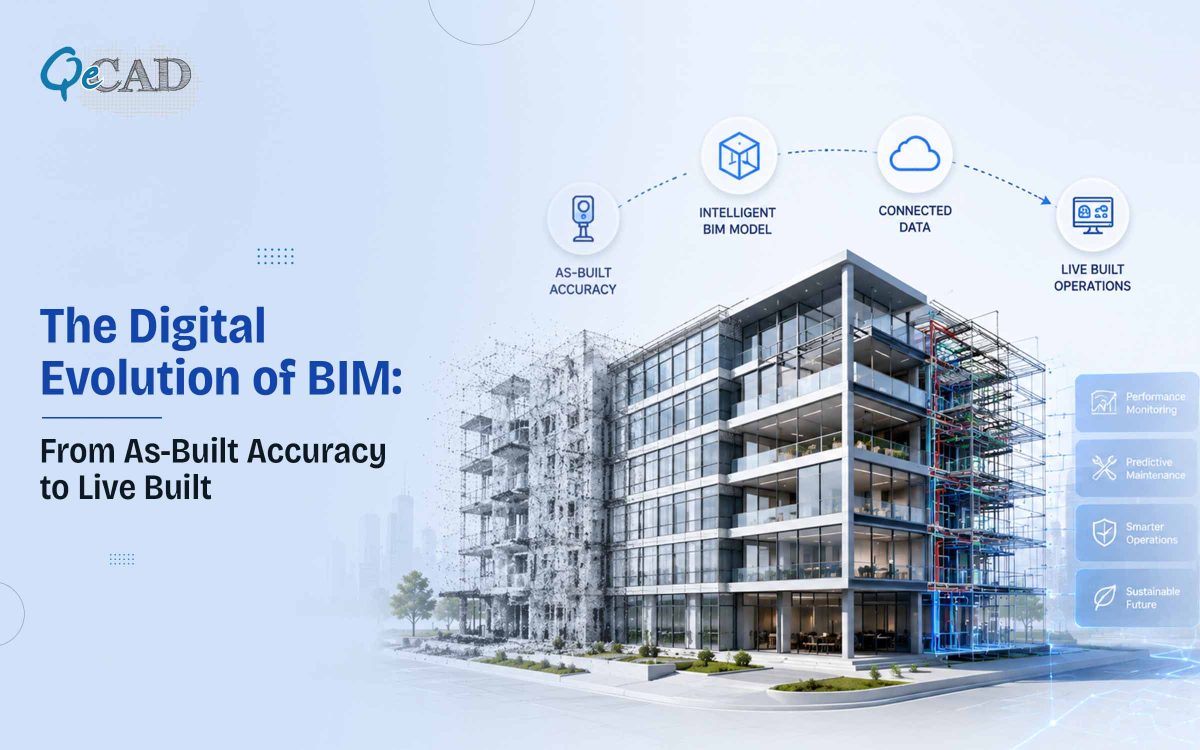
For years, BIM models primarily served as the design and coordination tools. Later, they evolved into “as-built” models that documented how a building was ultimately constructed. Today, however, the industry is moving beyond the static records towards something far more dynamic — the concept of “Live-Built” BIM models.
These next-generation models are no longer just historical documentation. They are becoming real-time digital environments that reflects the ongoing condition, performances and operational data of a facility throughout its lifecycle.
Understanding the Shift: From As-Built to Live-Built
Traditionally, as-built documentation represented the final condition of a project after the construction completion. Contractors and consultants updated these drawings to capture any deviations from the original designs thus ensuring that the facility owners had accurate records for the maintenance and future renovations.
While these records were essential, they still had limitations:
- Information often became outdated quickly
- Updates were manually managed
- Facility data remained fragmented
- Changes during operations were rarely reflected consistently
- Real-time performance insights were missing
This is where modern BIM workflows are changing the game.
The emergence of digital twins, IoT integration, cloud collaboration, laser scanning and automation has enabled the BIM models to evolve into continuously updated “Live-Built” ecosystems.
Instead of representing only what was built, BIM models are now capable of showing:
- What currently exists
- How systems are performing
- What maintenance is required
- Where assets are located
- How spaces are being utilized
- Which components may fail in the future
The Role of Accurate As-Built Documentation
The foundation of every reliable Live-Built model still begins with precise construction documentation. High-quality QeCAD projects increasingly rely on accurate As Built Drawing Services to establish the trustworthy baseline information for future digital operations.
Without accurate as-built data, even the most advanced BIM environments can become unreliable over time.
Today’s as-built workflows are significantly more advanced than the traditional redline markups. Modern technologies such as laser scanning, drone surveys, LiDAR capture and reality capture tools enables the teams to document the structures with exceptional precision.
These technologies helps to eliminate the common project issues such as:
- Dimensional inaccuracies
- Missing site conditions
- Coordination conflicts
- Incomplete asset information
- Inconsistent facility records
As projects become more complex, especially in healthcare, industrial, infrastructural and commercial sectors, the importance of data-rich as-built models continues to grow.
How Scan-to-BIM Accelerates the Evolution?
One of the biggest drivers behind the Live-Built workflows is the growing adoption of Scan to BIM Services.
Using laser scanners and point cloud technology, the teams can capture the existing site conditions with millimeter-level accuracy and rapidly convert them into intelligent BIM models.
This process is especially valuable for:
- Renovation projects
- Heritage structures
- Industrial facilities
- Facility upgrades
- Campus expansions
- Retrofit and modernization initiatives
Instead of relying on outdated drawings or manual measurements, Scan-to-BIM workflows provides real-world spatial accuracy that becomes the foundation for operational BIM intelligence.
For example, facility managers can compare live site scans against the BIM models to detect structural movement, equipment displacement or maintenance deviations over time.
This continuous synchronization between the physical assets and digital models is what truly defines the transition towards Live-Built environments.
The Rise of Digital Twins in Construction
The concept of Live-Built BIM is closely tied to digital twins.
A digital twin is essentially a living digital replica of a physical asset that receives ongoing data from sensors, IoT devices, building management systems and operational platforms.
Unlike traditional BIM models, digital twins can provide:
- Real-time occupancy tracking
- Energy performance monitoring
- HVAC efficiency analysis
- Predictive maintenance alerts
- Asset lifecycle forecasting
- Environmental condition monitoring
For example, in a smart commercial building:
- Sensors can monitor air quality and temperature
- BIM-integrated systems can detect the equipment inefficiencies
- Facility teams can visualize the issues directly within the model
- Maintenance tasks can be automated based on the operational data
This creates a highly proactive approach to building management rather than just the reactive maintenance.
Why Live-Built Models Matter?
The shift toward Live-Built BIM models is not just a technological trend — it directly impacts project efficiency, operational costs and long-term asset performance.
1. Improved Facility Management
Facility teams gains instant access to accurate asset information thus reducing the time spent searching for the documentation or resolving maintenance issues.
2. Reduced Operational Costs
Real-time monitoring enables the predictive maintenance thereby helping the organizations to avoid expensive equipment failures and emergency repairs.
3. Better Renovation Planning
Updated digital models eliminates the uncertainty during the renovations, reducing clashes, reworks and unexpected site conditions.
4. Enhanced Sustainability
Live performance data supports the energy optimization and carbon reduction strategies hence helping the organizations to meet the sustainability targets.
5. Faster Decision-Making
Cloud-connected BIM environments allows the stakeholders to access the synchronized project information from anywhere.
Industries Leading the Adoption
Several industries are already rapidly embracing the Live-Built BIM workflows:
- Healthcare facilities
- Airports and transportation hubs
- Industrial manufacturing plants
- Smart commercial buildings
- Educational campuses
- Data centers
- Infrastructure projects
These sectors requires constant operational visibility, making dynamic BIM environments highly valuable.
For example, hospitals increasingly use live BIM models to monitor the critical equipment systems, while industrial facilities integrates BIM with the operational technology to improve the plant performance and safety.
Challenges Still Facing the Industry
Despite the advantages, the transition towards Live-Built BIM also presents challenges.
Data Management Complexity
Real-time BIM environments generate enormous amounts of operational data that requires secure and structured management.
Standardization Issues
Different software platforms, asset standards and data formats can create interoperability problems.
Skill Gaps
Organizations need professionals who understand BIM, data analytics, IoT systems and facility operations together.
Initial Investment
Advanced scanning technologies, sensors, cloud platforms and BIM integration systems requires upfront investment.
Despite the upfront investment, the long-term improvements in efficiency and operational performance often deliver greater value.
The Future of BIM is Continuous
The future of BIM is no longer about the static deliverables handed over at the project completion. Instead, BIM models are becoming intelligent operational platforms that evolves continuously throughout a building’s lifecycle.
As technologies like AI, IoT, digital twins and automation matures further, Live-Built environments will become increasingly predictive, autonomous and interconnected.
In the coming years, BIM models may not only monitor the facilities but also recommend the operational improvements, automate the maintenance scheduling, optimize the energy usage and support fully autonomous building management systems.
Conclusion
The evolution from As-Built to Live-Built represents one of the most important shifts in the construction and facility management industry.
What began as simple documentation has evolved into intelligent, living digital ecosystems capable of supporting smarter operations, better maintenance and more informed decision-making.
Organizations that invest early in accurate BIM workflows, reality capture technologies and integrated digital infrastructure will be better positioned to improve efficiency, reduce operational risks and maximize the asset value over the long term.
As the construction industry continues moving towards smarter buildings and connected infrastructure, Live-Built BIM models are rapidly becoming the future standard rather than an emerging concept.