

02 Nov 2026
Is Your BIM Model Ready for Digital Twin Integration?
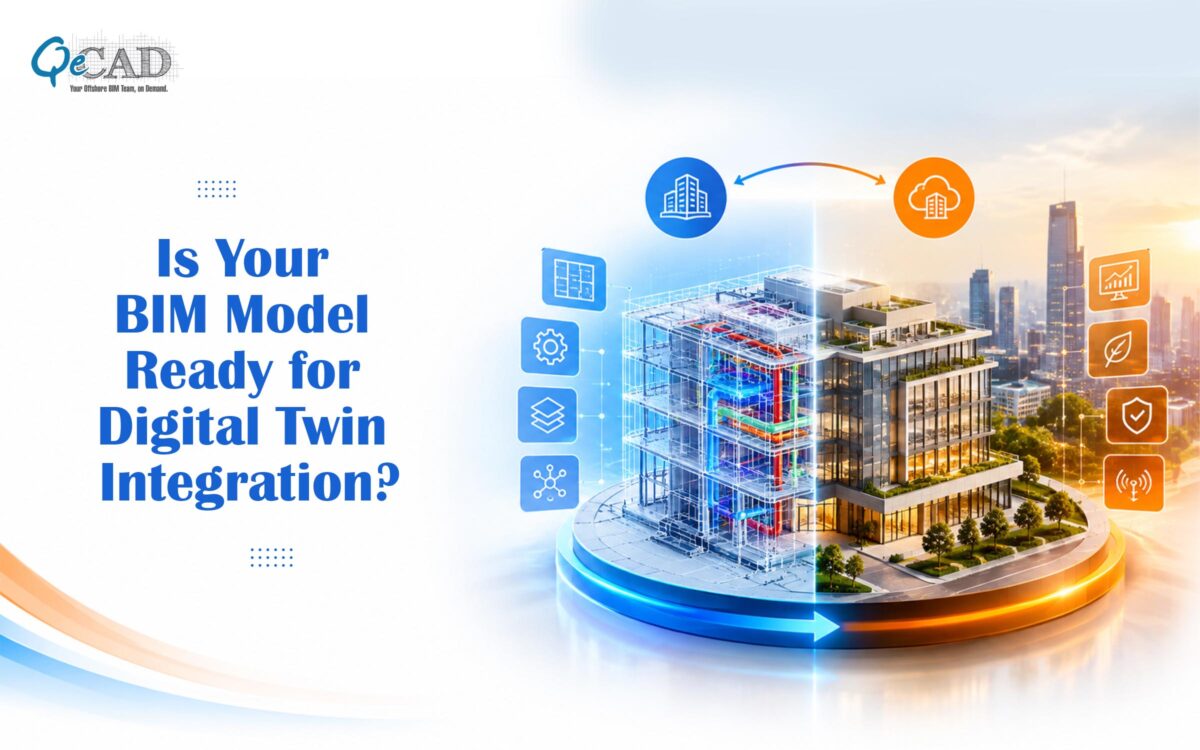
A BIM model can represent a building in remarkable geometric detail, but geometry alone does not make it suitable for the digital twin integration. A digital twin requires a model that can connect physical assets with structured data, operational information, sensors, maintenance records and real-world changes over time.
This creates an important distinction: a BIM model is not automatically a digital twin-ready model. It must be structured, validated, information-rich, interoperable and prepared to support data beyond design and construction.
So, what makes a BIM model ready for digital twin integration?
1. Accurate and Reliable Geometry
The foundation is still geometry.
Walls, floors, doors, equipment, structural elements, MEP systems and other assets must be modeled accurately enough to represent the physical environment. For existing buildings, this may require Scan to BIM or point-cloud-based modeling to establish reliable as-built conditions.
However, digital twin readiness goes beyond visual accuracy. Model elements should have consistent coordinates, correct spatial relationships, appropriate levels and logical system associations.
A geometrically accurate model with inconsistent element data can still become difficult to integrate with operational platforms.
2. Structured Asset Information
A digital twin needs to understand what an object is, not simply where it exists.
Consider an air-handling unit. A BIM model might contain its dimensions, location, manufacturer, and family information. A digital twin may additionally require asset ID, equipment type, commissioning date, operating parameters, maintenance schedule, warranty information, sensor identifiers and replacement history.
This means BIM elements should contain structured parameters that can eventually connect to operational databases and facility-management systems.
The more consistently this information is organized, the easier it becomes to establish a reliable digital thread from design through operation.
3. Consistent Naming and Classification
Data integration becomes complicated when the same asset is identified differently across systems.
For example, an equipment item could be called “AHU-01” in the BIM model, “AHU001” in the facility-management platform, and “HVAC_001” in a sensor database.
A digital twin needs these systems to recognize that they refer to the same physical asset.
Consistent naming conventions, classification systems, asset IDs, parameter structures and metadata therefore become essential. Organizations should define information requirements and naming standards before model production rather than attempting to standardize data after handover.
4. Interoperability and Open Data
Digital twins rarely operate within one software ecosystem. A project may involve authoring platforms, common data environments, IoT platforms, facility-management software, analytics tools, and visualization environments.
Therefore, a BIM model should support appropriate exchange formats and interoperability workflows.
Open standards such as IFC can help transfer model information between platforms, while APIs and structured databases can support connections with operational systems.
The motto is not just to export a model. It is to make the information usable across the wider project technology environment.
5. Appropriate Level of Information
More information does not necessarily mean better information.
A digital twin requires relevant and reliable information for its intended use. An operations-focused twin may need detailed equipment data while having little need for excessive geometric detail hidden inside architectural finishes.
This is why Level of Development (LOD) and information requirements should be mentioned according to the intended application.
A model intended for energy monitoring, maintenance, space management, or predictive analytics will require different information from a model primarily created for construction coordination.
6. Model Validation and Data Quality
Poor-quality BIM data can propagate directly into digital twin workflows.
Before integration, models should be checked for duplicate elements, missing parameters, incorrect classifications, inconsistent naming, disconnected systems, geometric conflicts, and incomplete asset information.
Automated rule-based checking can help identify recurring data issues, while manual QA/QC remains valuable for validating complex project information.
A digital twin is only as dependable as the data feeding it.
7. Connection to Real-World Data
The key feature that distinguishes a digital twin is its relationship with the physical asset.
For this connection to work, BIM objects may need links to sensors, meters, equipment controllers, maintenance systems, or other operational data sources.
For example, a pump modeled in BIM could be associated with its real-world asset ID and connected to live information such as temperature, vibration, runtime or energy consumption.
The BIM model becomes the structured spatial and asset context through which operational data can be interpreted.
8. A Model Built for Lifecycle Use
Traditional BIM workflows often emphasize design coordination and construction documentation. Digital twin integration expands that perspective toward the entire asset lifecycle.
This means information should be structured with future operations in mind.
Data required for commissioning, maintenance, asset replacement, energy analysis, space management, and facility operations should be considered during model development rather than added as an afterthought.
For organizations working with external production teams, clearly defined BIM Services workflows can help establish these information requirements from the beginning. Similarly, BIM Outsourcing Services can support model development, data enrichment, QA/QC and standardization when internal teams need additional production capacity.
From BIM Model to Living Asset Data
Digital twin integration is ultimately less about creating a visually impressive model and more about creating a trusted information environment.
A digital-twin-ready BIM model should combine accurate geometry, structured asset information, consistent classifications, interoperability, validated data, and clear links to real-world systems.
The transition can be viewed as a progression:
Geometry → Information → Structured Assets → Connected Data → Operational Intelligence
BIM provides the structured foundation. IoT, sensors, APIs, analytics, and operational platforms can then extend that foundation into a dynamic representation of the physical asset.
The key question, therefore, is not simply, “Is the BIM model complete?”
It is:
“Can this model reliably connect the physical asset to the data that describes how it exists, performs, and changes?”
When the answer is yes, BIM moves beyond documentation and becomes a practical foundation for digital twin integration.