

25 Sep 2026
The Role of Asset Information Model (AIM) in BIM: A Complete Guide
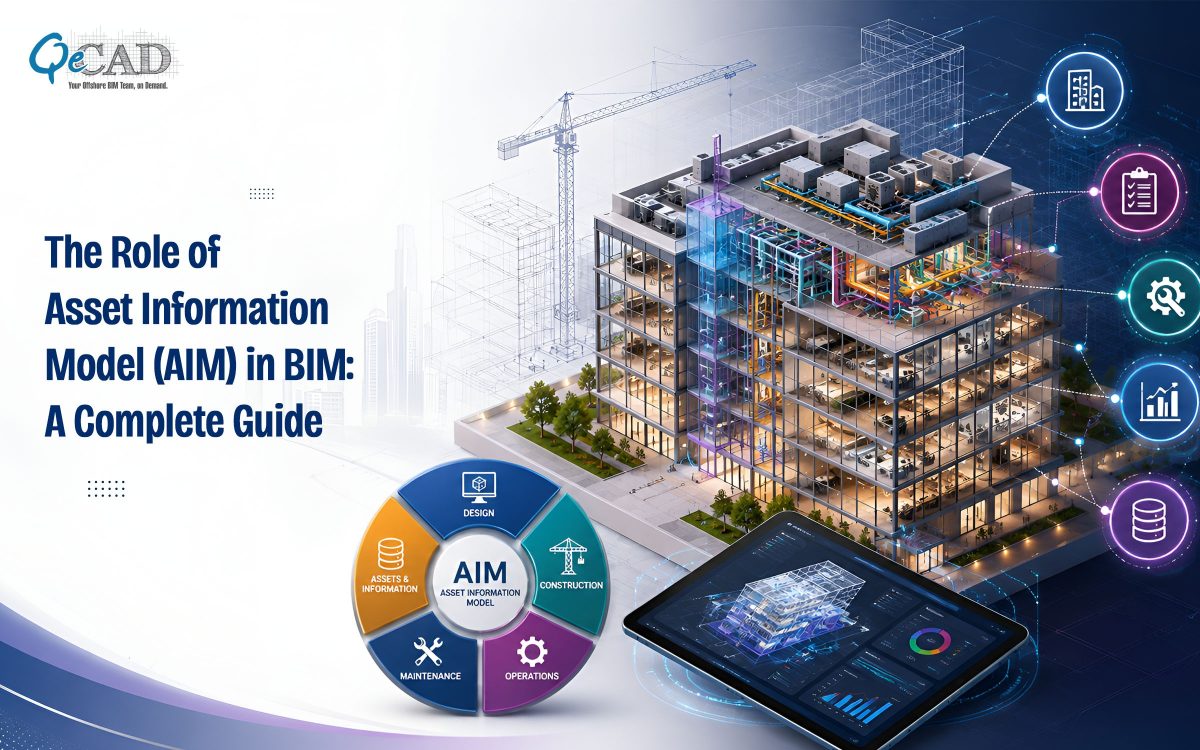
BIM is increasingly being used beyond design and construction to support the entire lifecycle of a built asset. While the Project Information Model (PIM) primarily supports the design and delivery, the Asset Information Model (AIM) focuses on what happens after an asset is constructed—its operation, maintenance, management and ongoing improvement.
Under ISO 19650, an AIM is an model that defines information relating to the operational phase of an asset. It can exist for part or all of an asset’s lifecycle and is intended to support the asset management activities.
What Is an Asset Information Model?
An Asset Information Model is a structured collection of information required to operate, maintain, manage and make decisions about a built asset throughout its operational life.
Importantly, AIM is not simply a 3D BIM model handed over after construction. It can combine graphical information, structured non-graphical data, documents, records and information from different systems and providers. ISO 19650-3 describes the AIM as a federated information model that can integrate information from multiple sources.
For example, an AIM for a commercial building may contain:
- As-built architectural, structural and MEP information
- Equipment and asset registers
- Manufacturer and product information
- Equipment specifications and performance data
- Operation and maintenance manuals
- Warranties and certificates
- Inspection and testing records
- Maintenance schedules
- Room and space information
- Asset identification codes
- Replacement and lifecycle information
- Relevant photographs and supporting documents
This creates a structured digital information base that facility managers and asset owners can use long after the construction team has left the project.
AIM vs PIM: What Is the Difference?
The distinction between AIM and PIM is primarily based on purpose and lifecycle phase.
| Aspect | Project Information Model (PIM) | Asset Information Model (AIM) |
| Primary phase | Design and construction | Operation and maintenance |
| Main purpose | Support project delivery | Support asset management |
| Main users | Designers, engineers, contractors | Owners, operators, facility managers |
| Information focus | Design, coordination, construction | Operation, maintenance, performance |
| Lifecycle | Project duration | Asset operational lifecycle |
The PIM contributes information to the AIM, but it is not accurate to think of AIM simply as a renamed PIM. Operational requirements should influence what information is collected during project delivery in the first place. The UK BIM Framework describes this relationship through requirements such as Organisational Information Requirements (OIR), Asset Information Requirements (AIR), Project Information Requirements (PIR) and Exchange Information Requirements (EIR).
How Is an AIM Created?
Creating a useful AIM starts before construction is completed. Asset owners first establish what information is required to operate and manage the asset. These requirements are translated into Asset Information Requirements (AIR), which define the information that needs to be collected and maintained.
During design and construction, relevant information is generated within the PIM. At appropriate information exchanges or handover points, verified information is transferred into the AIM.
A typical workflow is:
Define operational requirements → Establish AIR → Develop and manage PIM → Verify asset information → Handover → Populate AIM → Operate and maintain → Update AIM
This approach prevents a common problem: discovering at handover that the project contains large volumes of design and construction information but lacks the specific data required by facility management teams.
The UK BIM Framework notes that effective transfer from PIM into AIM should occur without loss of meaning or accessibility, allowing the information to remain useful during the operational phase.
What Information Does an AIM Contain?
The exact content depends on the asset owner’s requirements and the intended use cases. A hospital, airport, manufacturing facility, office building and highway network may require very different information.
For a building, an AIM may include a federated BIM model containing building elements and maintainable assets, linked to structured information such as:
Asset identity:
Unique IDs, asset classifications, locations, and relationships.
Technical information:
Manufacturer, model number, capacity, dimensions, specifications and operating parameters.
Maintenance information:
Maintenance frequency, procedures, inspection records, service history and replacement requirements.
Documentation:
O&M manuals, warranties, certificates, commissioning records, drawings, and photographs.
Spatial information:
Building, floor, room, zone and equipment locations.
Operational information:
Performance data, operational status, access requirements and relevant safety information.
The AIM can also be connected or integrated with enterprise systems such as Computerised Maintenance Management Systems (CMMS), Building Management Systems (BMS) and other asset-management platforms.
Why Is AIM Important for Facility Management?
The biggest advantage of AIM is that it transforms fragmented asset information into a structured and accessible information resource.
Without an effective AIM, facility teams may need to search through spreadsheets, PDFs, paper records, disconnected databases and outdated drawings to find information about equipment or building components.
With an appropriately structured AIM, users can potentially select an asset, identify its location and technical information, access associated documentation, review maintenance requirements, and connect that information with operational systems.
This can support:
- Faster maintenance planning
- Better asset tracking
- More informed replacement decisions
- Improved operational visibility
- Reduced information loss at handover
- Better lifecycle cost management
- More efficient facility management
- Improved decision-making
The UK BIM Framework highlights that reliable, accessible information enables organisations to understand what information they have, where it is located and who can access it—supporting more effective decision-making and asset management.
AIM and Digital Twins
AIM can also provide an important information foundation for more advanced digital asset strategies, including digital twins.
However, an AIM and digital twin are not interchangeable terms. An AIM primarily provides structured information required to manage an asset, whereas a digital twin may combine asset information with live or frequently updated operational data, analytics, sensors, simulations and other connected systems.
A well-managed AIM can therefore serve as an important information layer for organisations looking to develop more sophisticated digital-twin capabilities.
AIM in Existing Buildings
AIM is not limited to newly constructed assets. Existing buildings and infrastructure can also require structured asset information.
Where reliable records are unavailable, technologies such as laser scanning, point clouds, photogrammetry and reality capture can help establish accurate existing-condition information. This information can then be converted into appropriate BIM deliverables and integrated with operational asset data.
For organisations managing large property portfolios, this approach can gradually transform legacy documentation into a more structured digital information environment.
The Role of Accurate BIM Information
The value of an AIM ultimately depends on the quality, relevance, accuracy and accessibility of its information. A highly detailed model is not automatically a useful AIM if it contains unnecessary information while missing critical operational data.
This is why BIM production should be aligned with the owner’s information requirements from the beginning. Accurate modelling, structured asset data, consistent naming conventions, information validation and controlled handover processes all contribute to a more reliable AIM.
For organisations requiring accurate drawings and model-based documentation, Construction Drawing Services can support the production and coordination of information required during project delivery, while BIM Drafting Services can help develop structured graphical information that contributes to the wider BIM information workflow.
Conclusion
The Asset Information Model represents a shift from viewing BIM as primarily a design and construction technology to treating it as a framework for managing information throughout an asset’s operational lifecycle.
A successful AIM brings together verified graphical information, asset data, documentation, and operational records in a structured environment. More importantly, it ensures that the information created during a project continues to deliver value after construction is complete.
As asset owners increasingly focus on lifecycle performance, predictive maintenance, digital twins, and data-driven facility management, AIM is becoming an essential component of effective information management. Under the ISO 19650 framework, its purpose is clear: provide the right information needed to manage and operate assets effectively throughout their lifecycle.