

28 Oct 2026
Can AI Turn BIM Models into Construction-Ready Drawings?
Construction documentation sits at the point where design intent becomes information that can actually be built, reviewed, approved, priced, and maintained. Yet producing drawings from BIM models still involves substantial manual work: creating views, applying annotations, arranging sheets, checking references, updating dimensions, and revising documentation whenever the model changes.
AI is introducing new levels of automation into this workflow. The opportunity is not simply to use AI to “draw faster,” but to connect model intelligence, documentation rules, and human review into a more automated production pipeline.
The emerging workflow can be understood as:
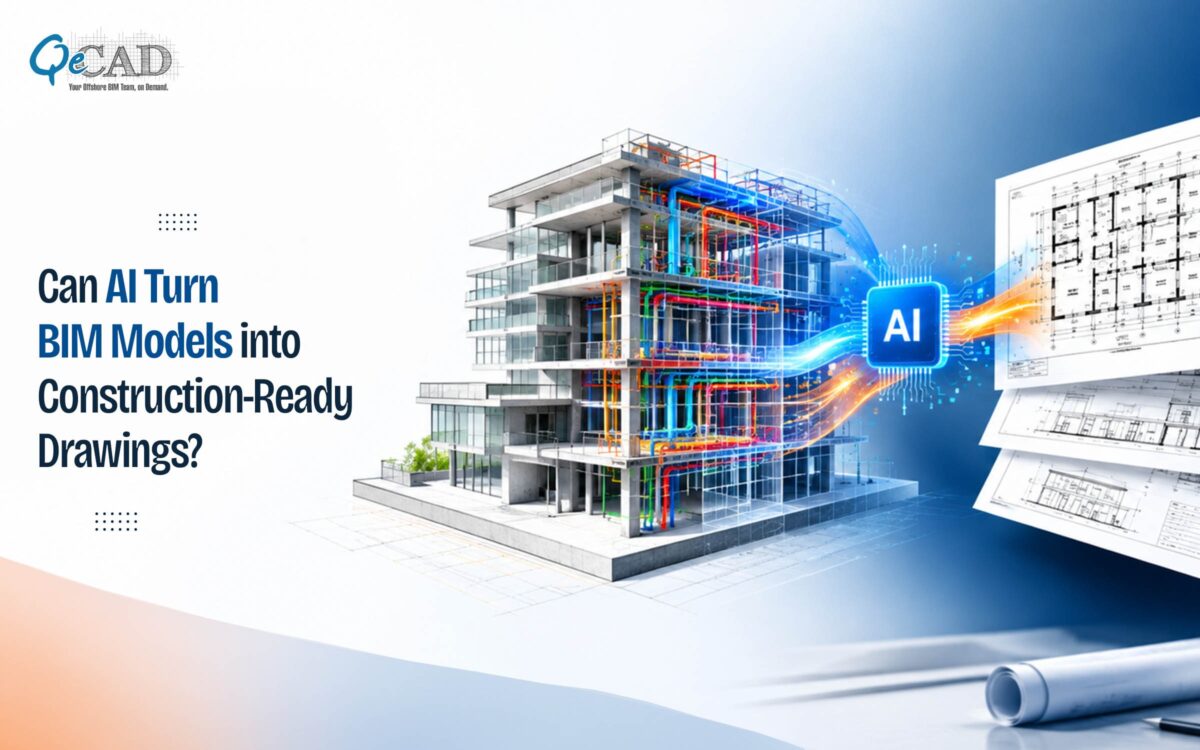
BIM Model → Structured Data → Rule Interpretation → View Generation → Annotation → Sheet Composition → Validation → Human Review
Why Construction Documentation Is Ready for AI?
The value of a BIM model extends well beyond its physical geometry. Elements can carry information about type, material, classification, dimensions, systems, levels, spaces, quantities, and relationships.
This makes BIM fundamentally different from disconnected 2D drafting. Instead of asking an AI system to interpret every line on a drawing, automation can potentially work from structured model information.
This distinction is important.
For example, a wall object can provide its location, height, thickness, material and relationship to adjacent elements. A door can contain its type, dimensions, fire rating and host wall. An MEP component can include system information, equipment data and connectivity.
The more structured the model, the more opportunities exist to automate downstream documentation.
From Model Data to Drawing Intelligence
The first stage is extracting usable information from the model.
An AI-enabled documentation workflow can analyze model objects and classify them according to documentation requirements. It may identify which elements belong in plans, elevations, sections, schedules or detail views.
For example, a documentation system could determine that:
- Architectural walls belong in floor plans and relevant sections.
- Doors require tags and schedule references.
- MEP equipment requires equipment tags and system information.
- Structural members require appropriate section and detail representations.
- Certain components require enlarged details because of their complexity.
This creates a shift from drafting individual views toward generating documentation from model relationships and rules.
AI Can Assist with View and Sheet Creation
One of the more practical opportunities is automated view generation.
Instead of manually creating every required view, an AI-assisted system could interpret a predefined documentation standard and identify the views required for a project stage.
For example:
Input: Coordinated BIM model + documentation requirements
AI workflow:
- Identify building levels.
- Detect major disciplines and systems.
- Determine required plan, elevation and section views.
- Apply view templates.
- Establish appropriate scales.
- Generate annotations and tags.
- Place views on predefined sheet structures.
- Flag missing or inconsistent information for review.
This does not mean AI independently decides what should be issued for construction. Rather, it can automate repetitive decisions within clearly defined rules.
That distinction is critical for professional documentation.
Intelligent Annotation and Scheduling
Annotations are another area where model-driven automation can deliver value.
AI can assist in identifying objects that require tags, dimensions, keynotes or schedule references. Because these annotations can be linked to model elements, changes to the underlying model can potentially trigger corresponding documentation updates.
Schedules can similarly become more automated.
Instead of manually maintaining door, window, equipment or material schedules, structured model information can populate them dynamically. AI can then help identify anomalies such as missing parameters, inconsistent naming or unexpected values.
buildingSMART’s Information Delivery Specification (IDS) provides an important foundation for this type of automation. IDS allows information requirements to be expressed in a computer-interpretable format and enables automated checking of IFC model information against those requirements.
The Role of AI in CAD-Based Documentation
Not every project begins with a fully structured BIM model.
Existing buildings, renovation projects and legacy documentation may involve PDFs, scanned drawings, raster images, point clouds or traditional CAD files.
This is where AI-assisted CAD Drawing Services can become particularly useful.
Computer vision and machine-learning techniques can help recognize lines, symbols, text, rooms and drawing patterns from legacy documentation. The extracted information can then be structured into editable CAD or BIM environments.
However, automated recognition should not be confused with automatic accuracy.
A scanned drawing may contain distorted geometry, overlapping annotations, incomplete dimensions or outdated information. Human validation remains necessary before the resulting documentation is treated as project-authoritative.
Quality Control Becomes Part of the Automation Loop
Automating drawing production without automating quality control simply moves the problem downstream.
A more mature workflow therefore combines generation with validation.
AI-assisted checking can look for issues such as:
- Missing dimensions
- Unidentified model elements
- Duplicate or inconsistent tags
- Missing sheet references
- Unused or incorrectly populated parameters
- Inconsistent naming conventions
- Unexpected changes between drawing revisions
- Views that do not contain the required model information
OpenBIM standards are increasingly supporting this direction. buildingSMART identifies IDS as a mechanism for predictable information exchange and automated validation of IFC data, although IDS itself focuses on alphanumeric information rather than detailed geometric requirements.
This means AI can operate alongside deterministic rule-based validation rather than replacing it.
Human-in-the-Loop Is Essential
Construction documentation is not purely a pattern-recognition problem.
A drawing can be technically generated yet still be unsuitable for construction because of project-specific conventions, contractual requirements, jurisdictional standards or design intent.
Therefore, the strongest workflow is not:
AI → Final Drawing
It is:
AI → Draft Documentation → Automated Checks → Human Review → Approved Drawing
The human reviewer remains responsible for professional interpretation and final approval, while AI handles repetitive and data-intensive activities.
This approach also aligns with the broader information-management principles of ISO 19650, which focus on managing, exchanging, recording, versioning and organizing project information. ISO 19650-1:2018 remains the current published edition, having been reviewed and confirmed in 2024.
What the Future Workflow Could Look Like?
Imagine a coordinated BIM model reaches a documentation stage.
Instead of a documentation team manually opening dozens of views and preparing every sheet, the system receives:
Model + Project Standards + Information Requirements + Drawing Templates
AI interprets the available data, identifies required documentation, generates candidate views, applies annotations and populates schedules.
A validation engine then checks the output against defined requirements.
The documentation team reviews exceptions rather than manually inspecting every repetitive operation.
This is where Construction Drawing Services can evolve—from primarily production-oriented drafting toward model-driven documentation management and quality control.
The Bigger Shift: Drawings Become Outputs of Information
The long-term significance of AI in construction documentation is therefore bigger than faster drafting.
The industry is moving toward a model in which drawings are generated from structured project information rather than maintained as isolated documents.
When the model is authoritative, documentation can become a controlled representation of that information for a particular purpose—construction, coordination, fabrication, approval or facility management.
AI can help integrate the space between AI can help bridge the gap between the underlying data and these different documentation outputs.
The goal is not to eliminate documentation professionals. It is to reduce repetitive production work, detect inconsistencies earlier, and allow technical teams to spend more time on decisions that require engineering and construction judgment.
The future of construction documentation is unlikely to be “AI-generated drawings.” It is more accurately described as intelligent, model-driven documentation—where structured project data, automation, validation and human expertise work together to produce reliable information for construction.