

01 Apr 2026
Reducing RFIs in Construction: The Importance of Accurate CAD Drawings
In construction projects, Requests for Information (RFIs) are a common yet costly occurrence. RFIs arise when the contractors, engineers or subcontractors requires clarification about the design details, dimensions, materials or specifications in the construction documents. While some RFIs are inevitable, a large percentage of them stem from unclear, incomplete or inaccurate drawings.
This is where accurate CAD drawings plays a crucial role. By ensuring clarity, precision and coordination in design documentation, CAD draftings significantly reduces the number of RFIs raised during the construction thus leading to smoother project execution.
Understanding RFIs in Construction
An RFI is essentially a formal query raised by the construction team when information in the drawings or documentation is unclear or missing. While RFIs helps to resolve the uncertainties, excessive RFIs can delay the decision-making, disrupts the workflows and also increase the project costs.
According to an industry reports, over 20% of RFIs are caused by incomplete or poorly coordinated drawings. Additionally, studies from the construction management platforms indicates that each RFI can take an average of 7–10 days to resolve, depending on the complexity of the issue and the communication chain.
When RFIs accumulate, the impact extends beyond the paperwork. They often result in delayed approvals, stalled construction activities and potential rework on the site.
The Role of Accurate CAD Drawings
Accurate CAD drawings act as the foundation of clear construction documentation. When drawings are detailed, coordinated and aligned with the project specifications, contractors can execute the work with confidence and minimal confusion.
Professional Drafting Services ensures that the drawings are developed with a high level of precision, correct dimensions, standardized layers and proper annotations. This clarity allows the site teams to interpret the design intent correctly without needing any constant clarifications.
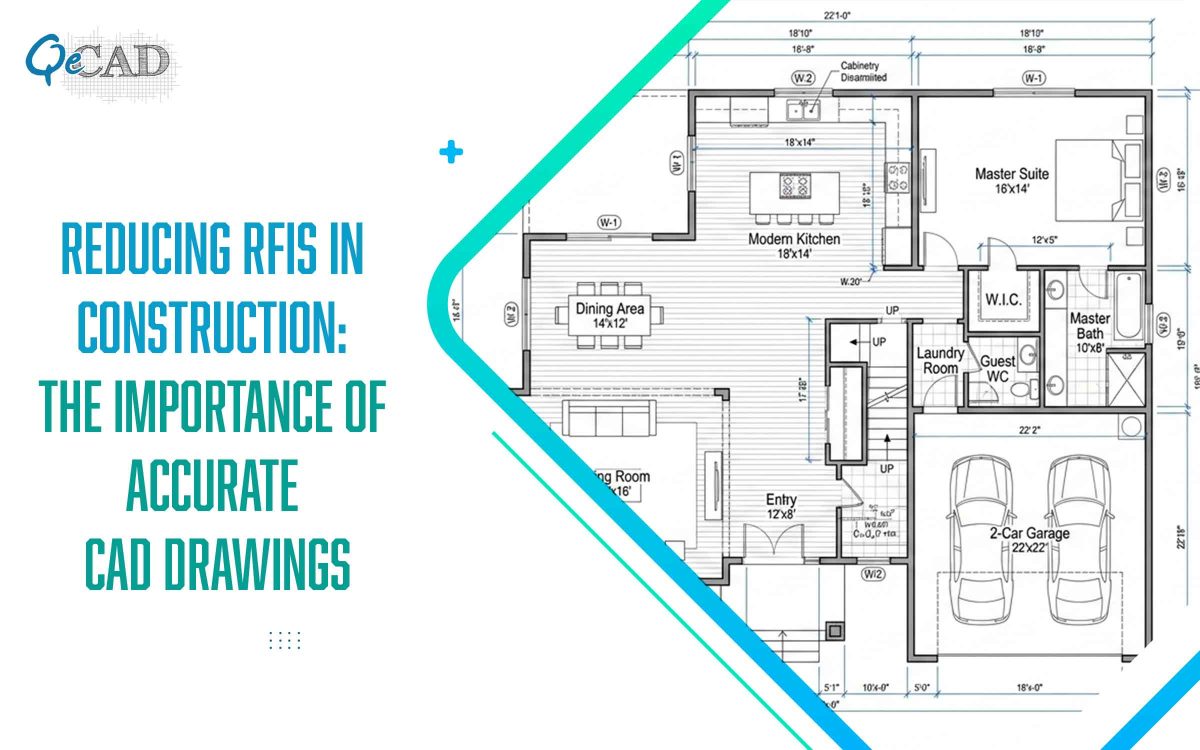
Similarly, well-prepared Architectural Drafting Services provides the structured floor plans, sections, elevations and even the detailed layouts that communicates the design information effectively to every stakeholder involved in the project.
Key Ways Accurate CAD Drawings Reduce RFIs
1. Eliminating Ambiguities in Design
Ambiguity in the drawings is one of the common reasons for RFIs. Missing dimensions, unclear notes or overlapping design elements forces the contractors to seek clarification before proceeding.
Accurate CAD drawings eliminates these ambiguities by providing clearly labeled components, precise measurements and consistent documentation standards.
2. Improving Coordination Across Disciplines
Construction projects involves multiple disciplines including the architectural, structural and MEP teams. If these drawings are not properly coordinated, clashes and inconsistencies arise.
Industry studies shows that nearly 30% of RFIs originates from the coordination issues between the disciplines. Accurate CAD documentation ensures the alignment between the different design packages thus reducing the confusion and preventing the conflicting information.
3. Providing Detailed Construction Information
Contractors rely heavily on the construction documents to execute work on the site. When the drawings includes comprehensive detailing, material specifications and installation guidelines, the site teams can proceed without any sort of interruptions.
Detailed CAD drawings reduces the guesswork hence allowing the contractors to follow the documentation directly rather than raising RFIs for clarification.
4. Supporting Faster Decision-Making
Even when the RFIs occur, a well-structured CAD documentation helps to resolve them quickly. Clear drawings enables the architects and engineers to identify the issues faster and provide prompt responses.
Research suggests that the projects with well-documented drawings experience up to 40% fewer RFIs as compared to the projects with incomplete documentation.
5. Reducing Rework and Cost Overruns
Every RFI has the potential to trigger the delays and reworks. If the construction proceeds based on incorrect assumptions due to any unclear drawings, the cost of correcting those mistakes can be substantial.
Accurate CAD drawings minimizes this risk by ensuring that the design intent is communicated correctly from the start thus preventing the costly on-site modifications.
The Broader Impact on Project Efficiency
Reducing RFIs does more than just simplifying the communication—it improves the overall project performance. When contractors work with the precise drawings:
- Construction progresses without frequent interruptions
- Project timelines remains more predictable
- Communication among project stakeholders becomes more streamlined
- The risk of disputes and contractual conflicts decreases
Ultimately, the accurate drafting contributes to better collaboration between the design teams and construction teams, which is essential for a successful project delivery.
Conclusion
RFIs may be a routine part of the construction projects, but a significant portion of them can be avoided through clear and accurate CAD documentation. When drawings are precise, coordinated and comprehensive, the contractors can execute the work with confidence and fewer uncertainties.
By investing in high-quality drafting and documentation processes, project stakeholders can significantly reduce RFIs, minimize delays, and improve construction efficiency. Accurate CAD drawings are not just technical documents—they are essential tools that ensure smoother communication, faster decision-making, and successful project outcomes.