

12 Mar 2026
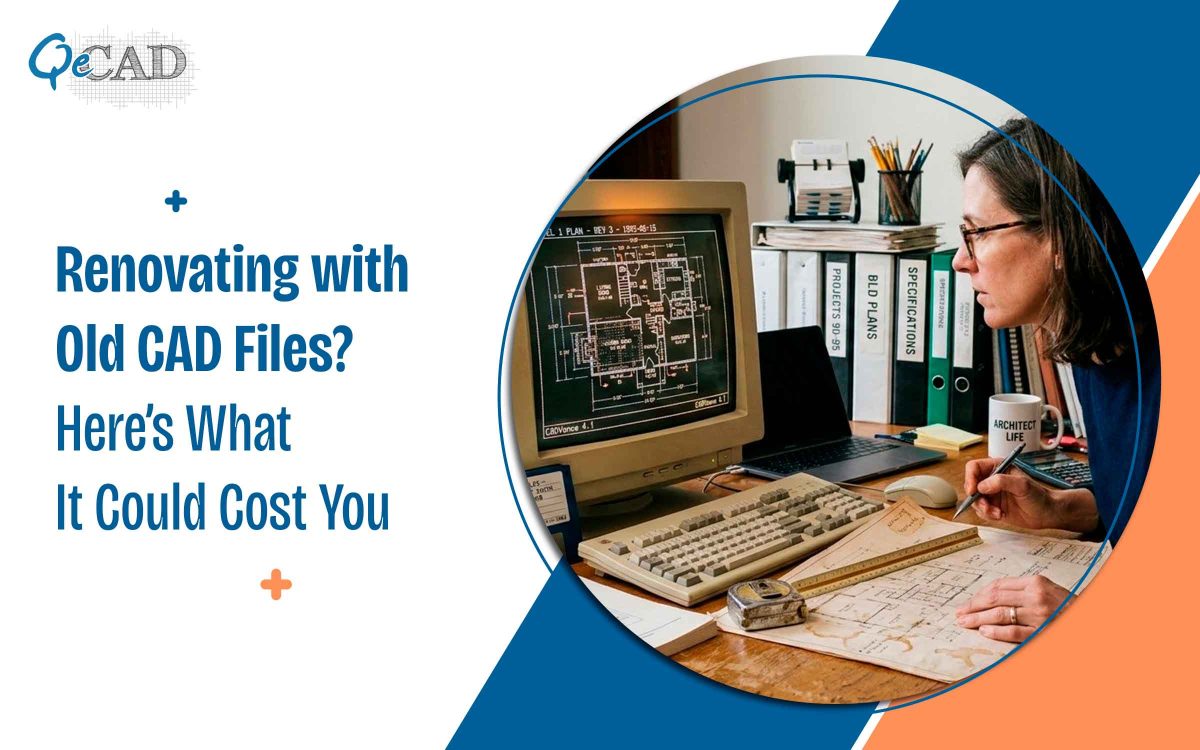
Renovating with Old CAD Files? Here’s What It Could Cost You
Renovation projects rarely fails because of bold ideas. They fail because of inaccurate information.
In theory, having existing CAD files for a building should make renovation easier. The drawings are already there. The layouts are defined. The structure is documented. But in reality, old CAD files often become one of the biggest hidden liabilities in renovation projects—especially when they are blindly trusted.
As someone who has seen multiple renovation cycles across commercial, healthcare and residential projects, I can confidently say this: outdated CAD data can quietly derail budgets, timelines and on-site coordination.
Let’s break down why.
“As-Built” Rarely Means What You Think It Means
Many renovation projects begin with a file labeled As-Built.dwg. The assumption? It reflects current site conditions.
In practice, most “as-built” drawings are actually:
- Permit drawings with minor markups
- Contractor-issued revisions that were never consolidated
- Partial updates after phased renovations
- Files saved from an older version without validation
Over the years, small undocumented changes accumulates:
- Partitions relocated
- MEP services rerouted
- Equipment upgraded
- Structural openings modified
If these changes were never properly updated, the CAD file becomes a historical reference—not a reliable design base.
And designing on top of the inaccurate data compounds errors.
Hidden Dimensional Inaccuracies
Older CAD drawings often contains subtle dimensional inconsistencies:
- Walls that don’t close perfectly
- Slight misalignments between plans and elevations
- Layer confusion from legacy drafting standards
- Scaled drawings created from PDFs
These might seem minor in design review—but during renovation, millimeters matters.
When fabricators, contractors or MEP teams rely on flawed geometry, issues show up on site:
- Ducts clashing with beams
- Millwork not fitting
- Ceiling heights miscalculated
- Services interfering with new layouts
By the time these errors surfaces, correction costs multiplies.
Legacy Drafting Standards Create Coordination Chaos
CAD standards evolve. Layer naming conventions, line weights, blocks, Xrefs—everything improves over time.
Old CAD files often suffer from:
- Exploded blocks
- Missing Xrefs
- Inconsistent layer naming
- No standardized annotation
- Unpurged data bloating file size
When renovation teams attempt to integrate new work into these files, coordination becomes slow and risky.
Instead of building forward, teams spend hours cleaning legacy data before the real design begins.
This is where professional CAD Drawing Services adds value—not just by drafting, but by rebuilding clean, structured, coordinated drawing sets aligned with the modern standards.
Structural & MEP Changes Are Rarely Documented Properly
One of the most dangerous assumptions in renovation is that the structural and MEP layouts match the original drawings.
In reality:
- Columns may have been reinforced.
- Slabs may have been cored.
- Mechanical systems may have been rerouted.
- Fire protection layouts may have changed.
If these modifications aren’t accurately captured, renovation work can compromise structural integrity or create safety risks.
This becomes critical in:
- Hospitals
- Industrial facilities
- Commercial office retrofits
- High-rise residential upgrades
Trusting outdated CAD data without validation can lead to major compliance and safety challenges.
Real-Life Example: The Ceiling That Didn’t Exist
In one mid-size commercial office renovation, the design team relied on 8-year-old CAD files for ceiling heights and MEP routing.
The drawings showed:
- Clear ceiling height: 3000 mm
- Duct routing aligned with corridor zones
- No structural drop beams in key areas
However, during demolition, it was discovered that:
- Additional HVAC systems had been added over the years
- A major chilled water line ran through the proposed conference room
- Structural reinforcement beams reduced ceiling clearance by 200 mm
The result?
- Redesign of the lighting layout
- Relocation of HVAC diffusers
- Reapproval of drawings
- 3-week delay
- Additional cost due to reworks
All because the project started with unverified CAD files.
A simple site scan before the design could have prevented it.
Renovation Demands Accuracy, Not Assumptions
Unlike new construction, renovation projects don’t start with a blank slate. They start with constraints.
And constraints demand:
- Verified dimensions
- Accurate structural data
- True MEP routing
- Updated elevations and sections
This is why many forward-thinking firms now combines the validation workflows like laser scanning with Scan to CAD Services before commencing the renovation design.
Instead of trusting legacy files, they:
- Capture the current site conditions
- Generate the updated CAD drawings
- Rebuild clean, coordinated base plans
- Then begin the design
This dramatically reduces the downstream risk.
Financial Risk Multiplies in Renovation
Here’s the reality: renovation margins are already tight.
Unverified CAD files can cause:
- Variation orders
- Change orders
- Fabrication waste
- Extended labor hours
- Approval delays
Each small drawing error becomes exponentially more expensive once the construction begins.
In contrast, investing in accurate base documentation at the start is often a fraction of the cost of mid-project corrections.
The Psychological Trap: “We Already Have the Drawings”
One of the greatest challenges isn’t technical—it’s psychological.
When clients say:
“We already have the CAD files.”
It fosters a misleading sense of preparedness.
But files alone don’t guarantee accuracy.
Before starting any renovation, key questions should be asked:
- When were these drawings last verified on-site?
- Were all previous renovations incorporated?
- Are structural and MEP systems updated?
- Do sections match plans?
If the answer is uncertain, the CAD files are not assets—they’re liabilities.
What Smart Renovation Teams Do Differently
Successful renovation teams follow a disciplined approach:
✔ Validate before the design
✔ Clean legacy CAD files
✔ Standardize layer structures
✔ Cross-check the structural and MEP data
✔ Rebuild base documentation where needed
They treat existing drawings as references—not truth.
Final Thoughts
Old CAD files are not inherently bad. They are valuable historical documents.
But in renovation projects, history is not enough.
Renovation demands precision and precision demands verified data.
Trusting outdated CAD files without validation is like renovating a house based on memory instead of measurement. It might look efficient at first—but the hidden risks surface when it’s too late.
If there’s one takeaway for renovation teams, architects, contractors and developers, it’s this:
Before redesigning the future, verify the present.