

27 Apr 2026
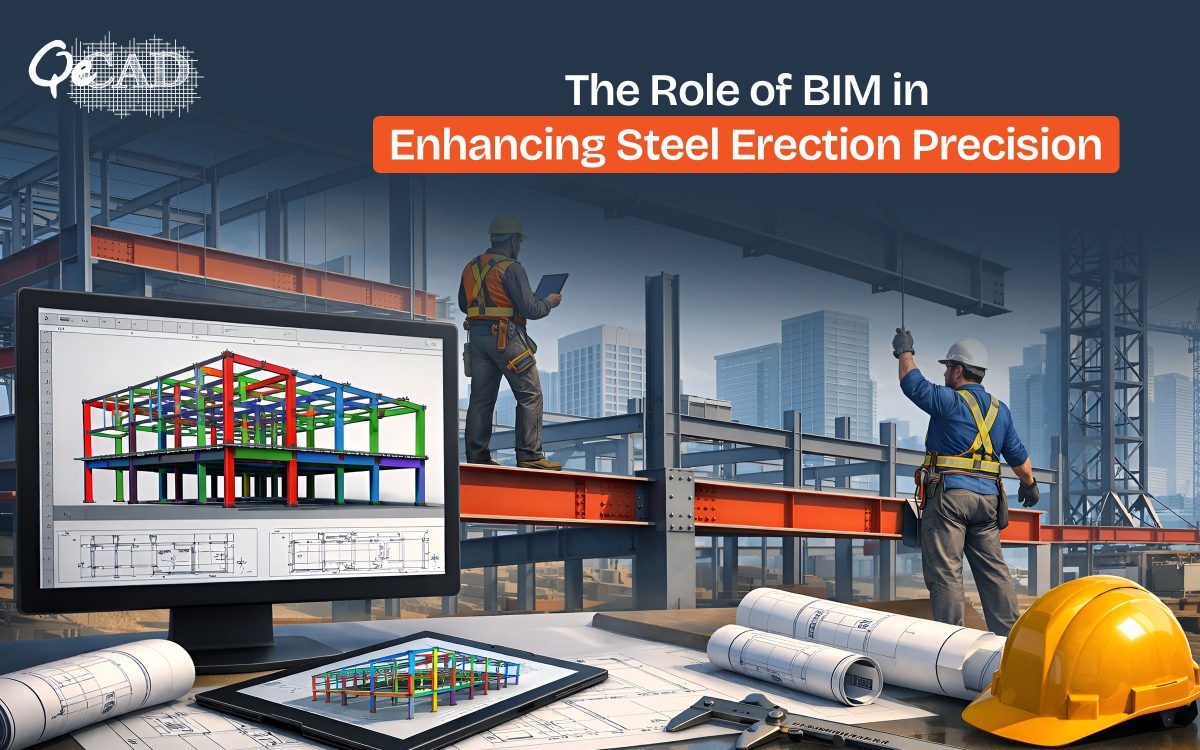
The Role of BIM in Enhancing Steel Erection Precision
In modern construction, steel structures calls for a high degree of accuracy, coordination and efficiency. Even the minor discrepancies in detailing can lead to costly reworks, project delays and safety risks during the erection. This is where BIM-based steel detailing is transforming the traditional workflows bringing accuracy, predictability and seamless coordination to the forefront.
The Challenge with Conventional Steel Detailing
Traditional 2D detailing methods often fall short when handling the complex steel structures. Common issues includes:
- Inconsistent drawings across disciplines
- Limited visualization of connections and assemblies
- Higher risk of fabrication and installation errors
- Difficulty in managing revisions and updates
According to the industry studies, reworks due to the design and detailing errors can account for up to 10–15% of total project costs, with steel structures being particularly sensitive due to tight tolerances.
What is BIM-Based Steel Detailing?
BIM-based steel detailing involves creating intelligent, data-rich 3D models that represent every steel component—beams, columns, connections, bolts and welds with precise geometry and specifications.
Unlike traditional methods, BIM integrates the design, detailing, fabrication and erection workflows into a unified digital environment, enabling all the stakeholders to work with accurate, real-time information.
How BIM Enhances Erection Accuracy?
1. High-Precision 3D Modeling
BIM allows for the creation of comprehensive 3D models that reflect actual fabrication requirements. Each element is modeled to precise dimensions with controlled tolerances thus minimizing the ambiguity during erection.
Impact:
- Reduces misinterpretation of drawings
- Ensures that components fits perfectly on-site
2. Clash Detection and Coordination
One of the known advantages of BIM is automated clash detection. Steel models are coordinated with the architectural, MEP and structural elements to identify conflicts before the construction begins.
Impact:
- Eliminates the on-site clashes
- Prevents costly reworks and delays
- Improves inter-trade coordination
Projects utilizing BIM coordination reports up to 40% reduction in field conflicts.
3. Accurate Fabrication Data
BIM models generate fabrication-ready outputs such as shop drawings, CNC files and bills of materials directly from the model.
Impact:
- Reduces manual errors in detailing
- Ensures consistency between design and fabrication
- Improves manufacturing precision
This directly supports the efficiency of Steel Detailing Services, ensuring that what is designed is exactly what gets fabricated.
4. Improved Connection Detailing
Connections are critical in steel structures and often the most complex to execute. BIM allows for precise modeling of connections including bolts, welds and plates.
Impact:
- Eliminates the guesswork during installation
- Enhances the structural integrity
- Ensures compliance with the standards
5. Sequencing and Erection Simulation
BIM enables simulation of the erection sequence thereby allowing the teams to visualize how the structure will be assembled step by step.
Impact:
- Identifies the potential erection challenges in advance
- Optimizes crane usage and logistics
- Improves the site safety and planning
6. Real-Time Updates and Version Control
Any design changes are automatically updated across the model and associated drawings thereby ensuring that all the stakeholders are working with the latest information.
Impact:
- Reduces errors due to outdated drawings
- Improves communication across teams
- Enhances the project transparency
7. Enhanced Collaboration Across Stakeholders
BIM creates a centralized platform where the architects, engineers, fabricators and contractors collaborates effectively.
Impact:
- Streamlines communication
- Reduces RFIs and approvals time
- Improves overall project efficiency
Organizations leveraging advanced BIM Services reports up to 20–30% acceleration in project timelines.
Real-World Benefits of BIM-Based Steel Detailing
- Up to 50% reduction in reworks due to early issue detection
- Improved erection speed with accurate, pre-coordinated components
- Enhanced safety through better planning and visualization
- Cost savings from minimized material wastage and delays
Conclusion
In an industry where precision defines success, BIM-based steel detailing has become a critical enabler for achieving accurate and efficient erection. By bridging the gap between the design, fabrication and on-site execution, BIM minimizes the errors, enhances the coordination and ensures that the steel structures are assembled exactly as intended.
As the projects grow more complex and timelines more demanding, adopting BIM-driven workflows is no longer optional—it is essential for delivering high-quality, error-free steel construction.