


11 Aug 2026
The Role of Digital Models in Accelerating Off-Site Manufacturing
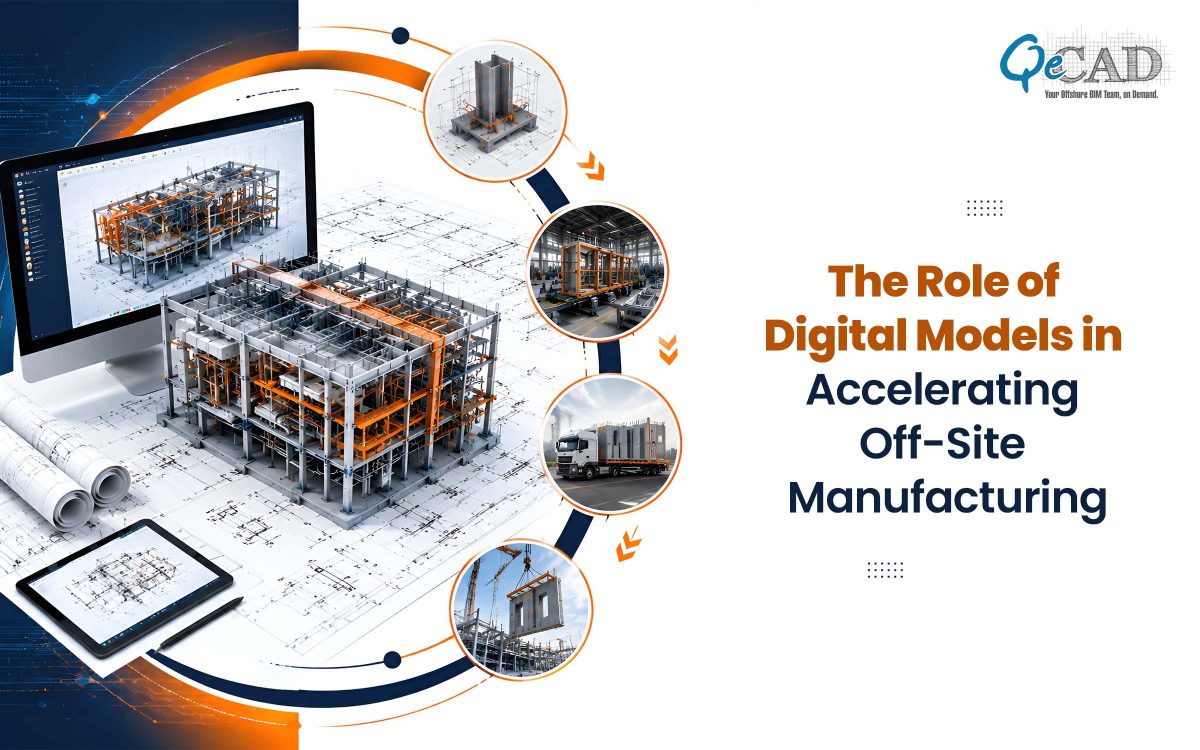
The construction industry is steadily moving away from the traditional on-site building methods towards manufacturing-driven approaches. Off-site manufacturing, which includes prefabrication, modular construction and component-based assembly, is transforming how the buildings are designed and delivered. However, the successful off-site manufacturing depends on one critical factor: accurate digital models.
Unlike conventional 2D drawings that often requires interpretation, the digital building models provides manufacturers with a complete representation of every building element, including dimensions, materials, tolerances, fabrication details and installation sequences. These models creates a seamless connection between the design teams, manufacturers and construction crews, significantly reducing the errors and improving project efficiency.
As construction projects become increasingly complex, digital models have become the foundation for precision manufacturing, enabling factories to produce building components with the same level of accuracy found in modern manufacturing industries.
Why Off-Site Manufacturing Requires Digital Precision?
Manufacturing building components in a factory leaves little room for design inconsistencies. Unlike traditional construction, where adjustments can often be made on-site, prefabricated components must fit perfectly when delivered to the project location.
Digital models eliminate ambiguity by providing:
- Accurate geometric information
- Material specifications
- Assembly relationships
- Manufacturing dimensions
- Installation references
- Coordination between architectural, structural and MEP systems
This level of detail ensures that factory-produced elements arrive ready for installation without requiring costly modifications.
A Single Source of Truth Across Teams
The major challenges in construction projects is maintaining consistency between multiple disciplines.
AEC professionals, contractors and manufacturers all require access to the same design information. Digital models serve as a centralized data source where every stakeholder works from the latest coordinated information.
This minimizes:
- Version conflicts
- Design discrepancies
- Communication gaps
- Manufacturing errors
- Installation delays
Instead of relying on multiple drawing revisions, every participant references the same digital model throughout the project lifecycle.
Improved Coordination Before Manufacturing Begins
Manufacturing mistakes are significantly more expensive than correcting issues during the design.
Digital coordination allows project teams to detect clashes between structural, architectural and MEP systems before fabrication begins.
Examples includes:
- HVAC ducts intersecting structural beams
- Pipe routing conflicts
- Insufficient installation clearances
- Misaligned wall openings
- Incorrect sleeve locations
Resolving these issues virtually prevents expensive factory reworks and minimizes installation delays.
According to studies by the National Institute of Building Sciences (NIBS), effective digital coordination can substantially reduce construction reworks, which has historically accounted for a significant share of project costs.
Supporting Automated Fabrication
Modern manufacturing facilities increasingly rely on CNC machines, robotic fabrication systems and automated production equipment.
Digital models provide machine-readable information that can be directly used for:
- Steel fabrication
- Timber cutting
- Concrete panel production
- Rebar bending
- Pipe fabrication
- Modular unit manufacturing
Instead of manually interpreting drawings, manufacturers can extract fabrication data directly from digital models, improving consistency while reducing the manual input errors.
This integration shortens production cycles and enhances manufacturing quality.
Better Quantity Accuracy
Accurate material quantities are essential for factory production planning.
Digital models enable automatic extraction of:
- Steel quantities
- Concrete volumes
- Pipe lengths
- Duct sizes
- Door and window schedules
- Fixture counts
This improves procurement planning while minimizing the material waste.
McKinsey & Company estimates that industrialized construction methods, supported by digital technologies, can improve productivity by up to 50% while significantly reducing material waste and project timelines.
Standardization Makes Manufacturing Easier
One of the biggest advantages of off-site manufacturing is repetition.
Digital models help teams standardize:
- Wall panels
- Bathroom pods
- Structural modules
- Mechanical racks
- Utility corridors
- Façade panels
Standardized components simplify factory production, improves quality control and accelerate assembly.
Instead of designing every component individually, manufacturers can efficiently produce repeatable modules with consistent quality.
Improved Construction Sequencing
Digital models provide more than geometric information—they also support construction planning.
When integrated with scheduling data, teams can visualize:
- Manufacturing timelines
- Transportation schedules
- Crane operations
- Installation sequences
- Site logistics
- Material deliveries
This enables manufacturers to produce components in the exact order required on-site, reducing storage requirements and supporting just-in-time delivery.
The result is a smoother transition from factory production to site installation.
Enhanced Quality Assurance
Quality control begins long before manufacturing starts.
Digital models allows manufacturers to verify:
- Component dimensions
- Tolerance compliance
- Connection details
- Material specifications
- Fabrication requirements
- Installation compatibility
Since every manufactured element is based on verified digital information, factories can maintain consistent quality across large production volumes.
Digital inspection workflows further improve traceability by linking manufactured components with production records and quality documentation.
Supporting Sustainable Construction
Off-site manufacturing contributes to sustainability by reducing waste, minimizing the site disruption and improving the resource efficiency.
Digital models further strengthen these benefits by enabling:
- Accurate material estimation
- Optimized cutting patterns
- Reduced transportation inefficiencies
- Lower reworks
- Better energy analysis
- Improved lifecycle planning
Factory-controlled production environments also generates less waste compared to the conventional construction sites.
As sustainability targets become more demanding, digital workflows are becoming an essential part of environmentally responsible construction.
Real-World Example
The healthcare sector has increasingly adopted modular construction to meet growing infrastructure demands. Several hospitals worldwide have used digitally coordinated models to manufacture patient rooms, MEP service modules and bathroom pods off-site.
Because every component was produced using coordinated digital information, installation was completed rapidly with minimal on-site modifications. This approach reduced disruption around active healthcare facilities while accelerating project delivery and maintaining high quality standards.
The Role of BIM Services
While digital models are central to off-site manufacturing, their effectiveness depends on the quality, coordination, and accuracy of the information they contain. Professional BIM Services help create highly detailed, coordinated models that support fabrication, quantity take-offs, clash detection and construction sequencing. By connecting design intent with manufacturing requirements, these services enable smoother collaboration between project stakeholders and factory production teams, reducing risks while improving the speed, precision and overall project outcomes.
Conclusion
Off-site manufacturing represents a major shift in how buildings are delivered, bringing the precision of industrial production to the construction sector. However, this transformation is only possible when manufacturers can rely on accurate, coordinated and information-rich digital models.
From design coordination and automated fabrication to quality assurance, logistics, and installation planning, digital models serve as the backbone of the entire off-site manufacturing process. They reduce uncertainty, improve collaboration and ensure that prefabricated components arrive ready for seamless assembly.
As modular construction and industrialized building methods continues to gain momentum worldwide, organizations that invest in high-quality digital modeling will be better positioned to deliver faster, safer and more cost-effective construction projects with greater confidence.