

04 Aug 2026
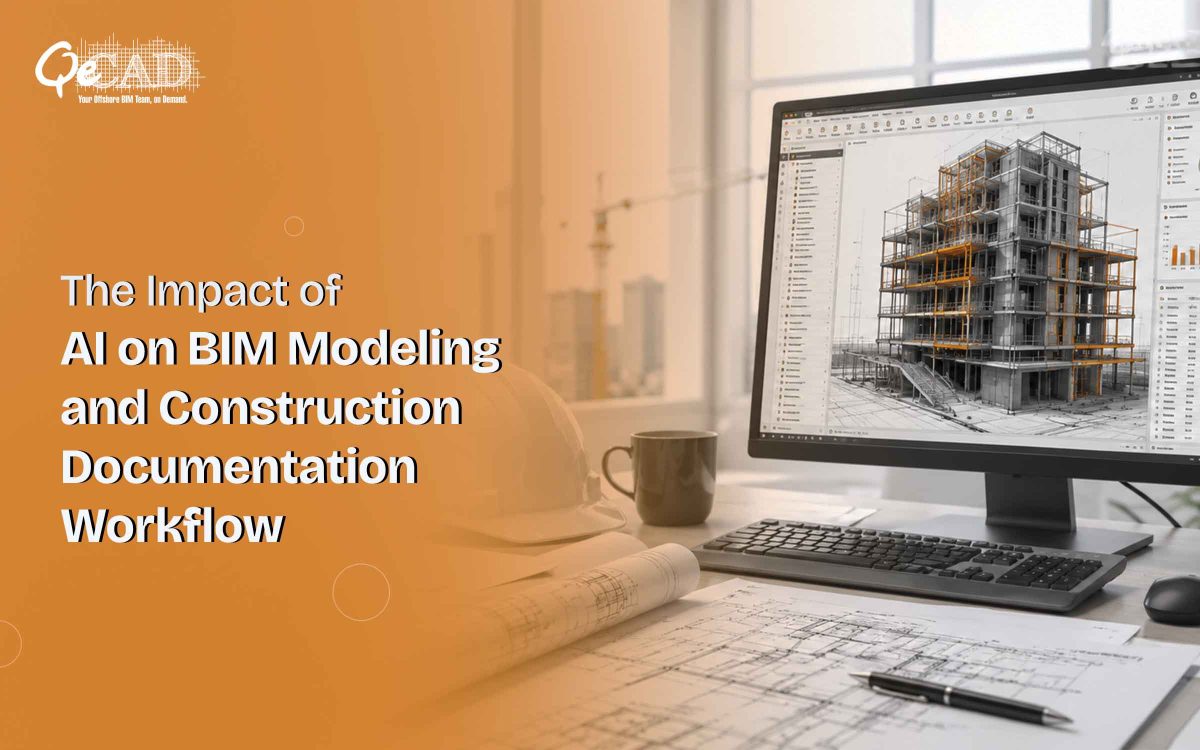
The Impact of AI on BIM Modeling and Construction Documentation Workflows
AI is rapidly transforming the AEC industry by making the design workflows smarter, faster and more accurate. While BIM has already revolutionized the project planning and coordination, the integration of AI is taking these capabilities to a new level. From automating repetitive modeling tasks to improving documentation accuracy, AI is helping the project teams to deliver better outcomes with reduced effort.
As projects become larger, more complex and increasingly data-driven, AI-powered BIM workflows are enabling architects, engineers, contractors and consultants to make informed decisions throughout the project lifecycle.
The Evolution of AI in BIM
Traditional BIM workflows rely heavily on manual modeling, coordination and quality checks. Although BIM software has significantly improved collaboration, creating detailed models and construction documents still requires considerable time and expertise.
AI introduces automation and predictive intelligence into these workflows. Instead of simply creating digital models, AI analyzes the project data, recognizes design patterns, detects inconsistencies and assists professionals in making faster and more accurate decisions.
Rather than just replacing the BIM specialists, AI serves as an intelligent assistant that enhances the productivity while allowing the professionals to focus on engineering judgment and design optimization.
Automating Repetitive BIM Modeling Tasks
One of AI’s biggest contributions is reducing the time spent on the repetitive modeling activities.
AI can assist with:
- Automatic recognition of architectural as well as structural components from point cloud data.
- Intelligent placement of walls, floors, columns, beams and openings.
- Parametric object suggestions based on previous modeling patterns.
- Automated family selection and placement.
- Faster model updates when design revisions occurs.
These capabilities significantly reduces the manual effort while maintaining the consistency across the BIM model.
Faster and More Accurate Construction Documentation
Construction documentation requires precision because every drawing directly influences the procurement, fabrication and onsite execution. Even the minor errors can lead to delays, change orders and costly reworks.
AI improves documentation by:
- Automatically checking drawing consistency.
- Identifying missing dimensions or annotations.
- Verifying model-to-drawing accuracy.
- Detecting incomplete documentation before submission.
- Suggesting corrections based on the predefined standards.
As a result, project teams can produce highly reliable Construction Drawing Services with fewer manual quality-control cycles.
Intelligent Clash Detection
Traditional clash detection identifies conflicts between architectural, structural and MEP systems after models have been created.
AI expands this capability by:
- Predicting potential clashes during the modeling stage.
- Prioritizing critical clashes based on the project impact.
- Recommending optimal routing alternatives.
- Learning from previous coordination issues.
This proactive approach reduces the coordination meetings and helps to resolve issues before they affect the construction schedules.
Improved Quantity Take-offs and Cost Estimation
AI-powered BIM systems can automatically extract quantities from evolving models while identifying inconsistencies that may affect project budgets.
Benefits includes:
- Faster quantity calculations
- Improved material estimation
- Reduced measurement errors
- Real-time updates following design revisions
- Better support for procurement planning
This enables estimators to generate more reliable project cost forecasts throughout the design process.
Smarter Quality Assurance
Quality control traditionally involves multiple manual reviews performed by experienced BIM coordinators.
AI enhances this process by continuously analyzing models for:
- Missing components
- Duplicate objects
- Geometry inconsistencies
- Incorrect object classifications
- Non-compliance with project standards
Instead of waiting until project milestones, quality checks become continuous throughout the modeling process, improving the overall model reliability.
Enhanced Construction Documentation Management
AI also assists in organizing and managing large volumes of project documentation.
Capabilities includes:
- Automatic sheet generation
- Intelligent revision tracking
- Version comparison
- Drawing classification
- Automated naming conventions
- Document search using natural language
These features simplifies the document management and reduce administrative workload across multidisciplinary teams.
Better Decision-Making Through Predictive Analytics
Modern BIM models contains vast amounts of project information. AI transforms this data into actionable insights by identifying the trends and predicting project risks.
Examples includes:
- Forecasting schedule delays
- Predicting high-risk coordination zones
- Identifying constructability concerns
- Evaluating design alternatives
- Optimizing resource allocation
Project stakeholders can make proactive decisions rather than just reacting to issues after they occur.
Accelerating Scan-to-BIM Workflows
Processing laser scan data has traditionally been one of the most labor-intensive BIM activities.
AI significantly accelerates this workflow by:
- Recognizing building elements from point clouds.
- Classifying structural and architectural components.
- Reducing manual tracing.
- Improving feature extraction.
- Supporting faster as-built model creation.
This enables renovation, retrofit and facility management projects to move from site capture to intelligent BIM models more efficiently.
AI Improves Collaboration Across Teams
Construction projects involve architects, engineers, contractors, fabricators and owners working simultaneously.
AI strengthens collaboration by:
- Identifying coordination issues earlier.
- Providing intelligent design recommendations.
- Keeping project documentation synchronized.
- Automating change tracking.
- Reducing communication gaps between the disciplines.
With everyone working from accurate and up-to-date information, the project teams can make faster decisions and minimizes costly misunderstandings.
The Role of Human Expertise
Despite its growing capabilities, AI cannot replace the technical knowledge and professional judgment of experienced BIM specialists.
Successful BIM projects still depend on professionals who can:
- Interpret complex design intent.
- Apply engineering principles.
- Resolve unique project challenges.
- Validate AI-generated outputs.
- Ensure compliance with industry standards.
AI works best as a productivity tool that complements the human expertise rather than just replacing it.
The Future of AI in BIM
The next generation of AI-powered BIM solutions is expected to deliver even greater automation through generative design, real-time design optimization, digital twins, predictive maintenance and autonomous model validation. As these technologies continues to mature, project teams will benefit from improved efficiency, enhanced collaboration and more informed decision-making across every phase of the building lifecycle.
Organizations that embraces AI-enabled BIM Services today will be better positioned to handle increasingly complex projects while maintaining high standards of quality, accuracy and productivity.
Conclusion
Artificial Intelligence is reshaping the BIM modeling and construction documentation by automating repetitive tasks, improving model quality, accelerating documentation workflows and enabling the data-driven decision-making. Rather than just replacing the skilled professionals, AI empowers them to work more efficiently while reducing the errors and enhancing collaboration.
As AI technologies continues to evolve, they will become an integral part of delivering smarter, faster and more reliable construction projects, helping the AEC industry achieve higher levels of efficiency, precision and project success.