


28 Jan 2026
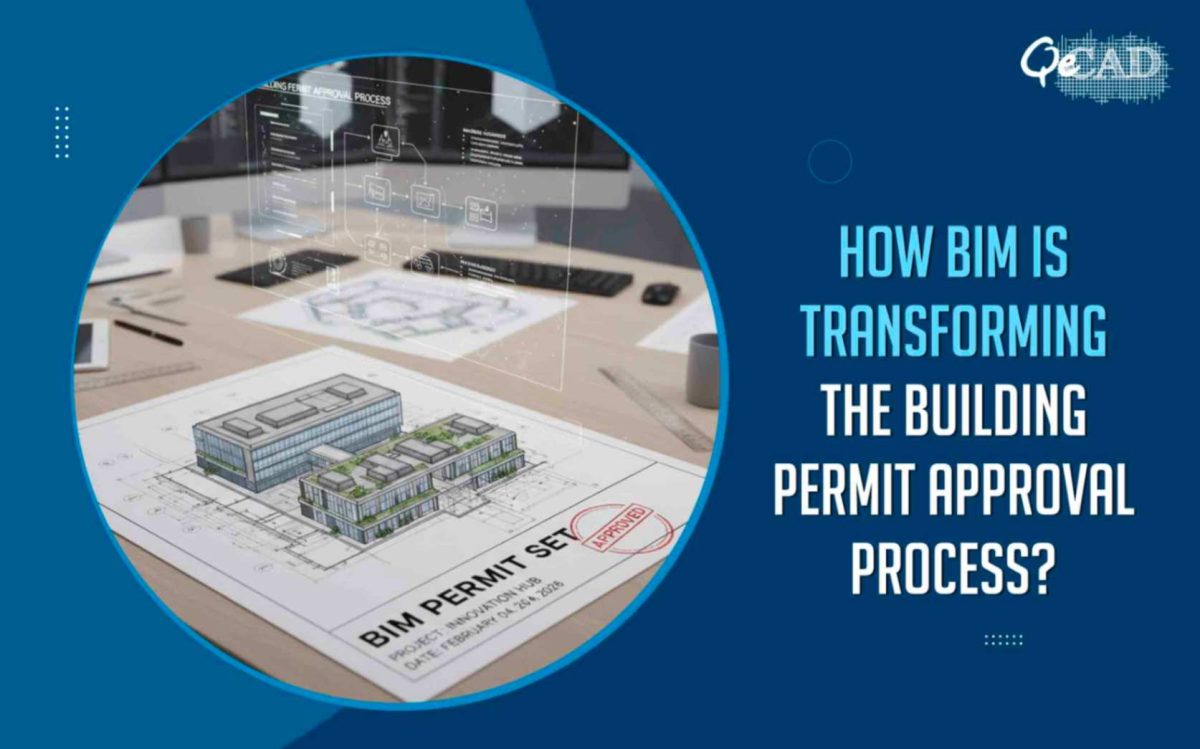
How BIM Is Transforming the Building Permit Approval Process?
In today’s rapidly evolving AEC industry, BIM has emerged as a transformative technology that not only enhances the design and construction workflows but also significantly accelerates the permitting and authority approval process. The traditional routes for securing the building permits have long been fraught with delays — manual plan reviews, fragmented documentation and interpretation challenges often costs weeks or even months in approval cycles. BIM is rewriting that narrative by enabling efficient, transparent and more accurate regulatory reviews.
1. Digital 3D Models Improve Visualization and Understanding
Unlike conventional 2D submissions, BIM produces the rich 3D digital models that captures the architectural, structural and MEP systems in a single integrated view. These models enables the authorities to visualize the complex designs instantly, facilitating quicker interpretation of compliance with local building codes, zoning restrictions, safety requirements and accessibility standards. Traditional plan rolls and flattened drawings often leads to interpretation errors and back-and-forth exchanges but BIM’s interactive model allows the code officials to zoom, pan and explore the building virtually thus leading to fewer misunderstandings and faster decisions.
2. Automated Checks Reduce Manual Review Time
Modern BIM tools comes equipped with the automated code compliance checks and clash detection functionalities. These tools can identify the potential conflicts within the design — such as fire egress issues, structural clashes or non-compliant spatial relationships — before the submission is even made. This pre-emptive problem detection dramatically reduces the number of revisions and resubmissions that often delays the permits.
According to the industry reports, incorporating BIM into the permit workflows can cut the review and approval times by up to 30–50% compared with the traditional processes — a major advantage for the developers racing against the tight project timelines. (Number Analytics)
3. Centralized and Comprehensive Submission Packages
BIM doesn’t just deliver a 3D model — it also acts as a central hub for all the project documentations. From regulatory compliance reports and energy performance analyses to the structural calculations and 4D scheduling data, BIM consolidates everything into a cohesive digital package. This eliminates the fragmented submissions involving multiple PDFs, spreadsheets and separate CAD files, which are time-consuming to organize and review.
For authorities, this means a more efficient workflow where each piece of required documentation is linked back to the model’s elements thus reducing the back-and-forth that typically stalls approvals.
4. Enhanced Collaboration Between Stakeholders and Authorities
One of the core strengths of BIM is how it fosters the collaboration. Designers, engineers, contractors and code officials can interact with a shared model in real time, comment directly on the elements and resolve the issues collaboratively. As BIM acts as a single source of truth, this shared environment discourages errors born from the version conflicts — a common problem in traditional 2D drafts.
A survey by Autodesk found that 75% of professionals believes that BIM enhances the collaboration, strengthening the coordination between the project teams and regulatory reviewers. (Number Analytics)
5. Digital Permitting Systems and BIM Integration
Forward-thinking governments around the world are now integrating BIM with the digital permitting systems. For instance, Abu Dhabi’s municipal authorities are adopting BIM and AI platforms that allows for the automatic compliance checks against the building codes, helping the consultants to submit the linked 2D and 3D data directly into the review systems for faster processing and decision-making. (Digital Construction Today)
In Europe, countries like Finland are already allowing direct submission of IFC-formatted BIM models into municipal permitting software thus enabling the semi-automated checks and reducing the manual intervention by code officials. This level of digital integration presents the next frontier in streamlining the permit approvals. (ACCORD partners)
6. Clearer Feedback and Fewer Revision Cycles
In traditional permitting contexts, insufficient documentation often triggers the multiple rounds of revisions — each adding the weeks of delay. BIM reverses this by providing accurate, fully coordinated models from the outset. When authority reviewers request changes, the design teams can update the centralized BIM model and automatically regenerate updated outputs (e.g., plans, sections, compliance sheets) hence reducing the turnaround time and improving the response efficiency.
7. Real-World Impact — Industry Figures and Trends
Here’s what the industry research shows about the BIM’s impact on permitting speeds:
- Up to 50% reduction in review and approval time when BIM is integrated into the permit process. (Number Analytics)
- Reduction in design errors by up to 40%, significantly minimizing the costly redesigns and resubmissions. (Number Analytics)
- McKinsey reports that the digital modeling techniques, like those embedded in BIM, can halve technical documentation approval timelines.
- 70% of EU municipalities are planning to shift to the BIM-based review systems in the near future — a testament to its increasing institutional adoption.
These figures illustrates that BIM isn’t just a design tool anymore — it’s becoming a regulatory compliance accelerator that pushes the AEC industry towards more predictable and efficient project cycles.
8. Seamless Hand-Off to Construction and Beyond
Once permits are secured, the same BIM model transitions into the construction execution and facilities management. Its rich dataset supports Construction Drawing Services, accurate shop drawings, sequencing, cost estimation and later even operations and maintenance. This seamless continuity further enhances the project value and reduces the administrative overhead across the building lifecycle.
Conclusion
BIM is redefining how permits and authority approvals are obtained in the built environment. By offering the digital clarity, automation, centralized documentation and collaborative review platforms, BIM speeds up the regulatory processes that once hindered the project momentum.
For developers, architects and engineers, embracing the BIM Services isn’t just about designing the smarter buildings — it’s also about securing the approvals faster, reducing uncertainty and delivering projects on schedule and within budget.