

16 Jan 2026
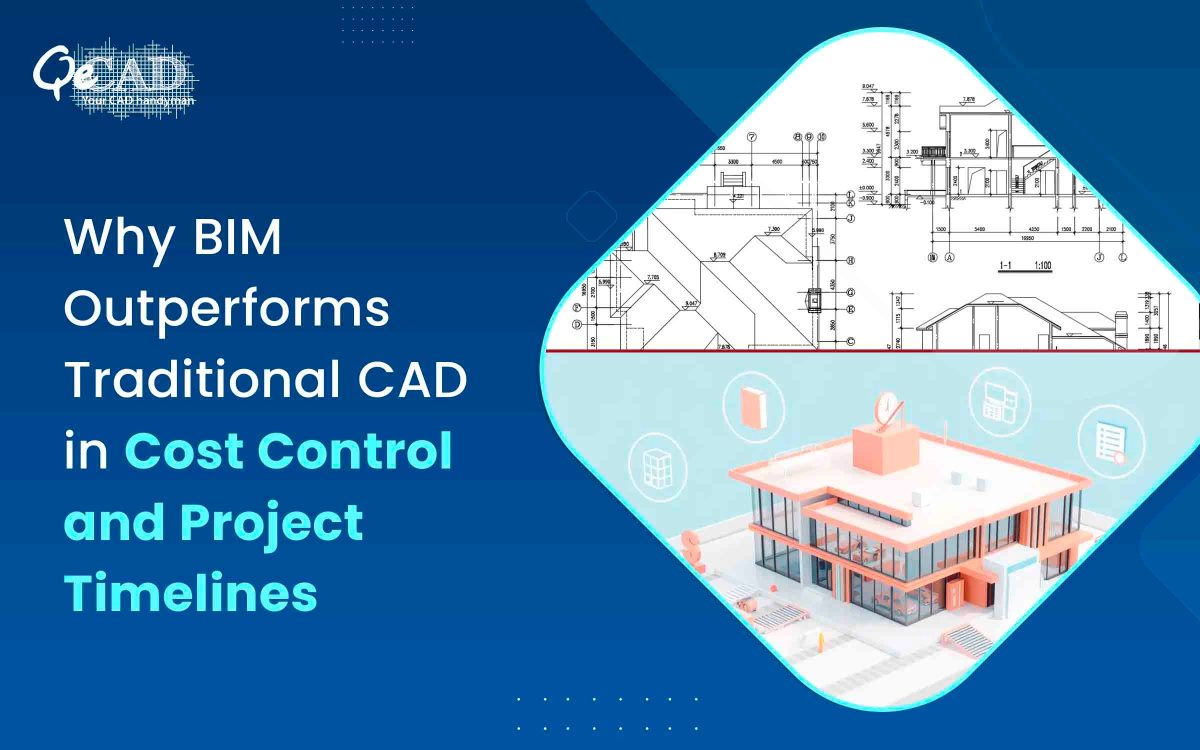
Why BIM Outperforms Traditional CAD in Cost Control and Project Timelines
In the fast-evolving world of AEC, the firms are continually challenged to deliver projects faster, more accurately and at lower cost. Two foundational design workflows — Traditional CAD Drawing Services and BIM Drafting Services represents very different approaches to the project delivery. While CAD has long been the industry staple for 2D drafting, BIM has rapidly emerged as the strategic standard for modern AEC firms looking to optimize efficiency, reduce risks and unlock measurable cost and time savings.
Understanding CAD and BIM: Foundations of Design Delivery
What is Traditional CAD?
Traditional CAD is primarily centered on producing 2D-based construction drawings and in some cases basic 3D representations of a design. These drawings serves as the detailed blueprints for construction documentation — but they are essentially a collection of independent sheets that must be manually updated when changes occur. This dependency on isolated files and manual coordination increases the likelihood of miscommunication, redundancies and costly errors during the later project stages.
What is BIM?
BIM is a data-rich, model-based process that integrates geometry, spatial relationships, quantities and even lifecycle information into a shared digital representation of a building. Beyond mere drawings, BIM models captures intelligence such as materials, scheduling data, cost information and more. BIM workflows fosters interdisciplinary coordination — capturing the entirety of the project lifecycle from planning and design to construction and facility management.
Real Cost Comparison: BIM vs CAD
1. Upfront Costs vs Long-Term Value
At first glance, transitioning from traditional CAD to BIM may appear more expensive due to software licensing, training and implementation costs. However, the real industry data shows dramatic long-term financial advantages:
- Many AEC firms across regions now reports that the standardized BIM adoption reduces the project delivery time by an average of 50% and can deliver 10–25% ROI on project cost savings with some projects exceeding these figures depending on the scale and complexity.
- BIM’s embedded cost estimation tools provide more accurate forecasts and reduce reworks — a key driver of budget overruns.
- In contrast, the traditional CAD workflows often entail high coordination costs due to manual file exchanges and updates, which can drain both time and money as projects grow in complexity. (BIM Training Institute)
According to industry insights, around 61% of U.S. construction firms use BIM on at least half of their projects, reflecting a broader market shift toward smarter, data-driven design processes. (Gitnux)
2. Reduced Rework and Error Costs
One of the single largest sources of project waste is rework caused by the design errors or miscommunication. BIM’s automated clash detection and real-time model updates catches conflicts early in the design process — before they become expensive issues on site. Traditional 2D CAD simply cannot provide this level of intelligent coordination which translates to higher downstream costs.
In fact, studies highlight:
- Firms using BIM reports substantial reductions in RFIs and coordination errors, resulting in more predictable cost outcomes and fewer delays.
- BIM’s ability to integrate cost and scheduling data ensures more accurate projections and less budget volatility throughout the project lifecycle. (Jisem Journal)
Real Time Comparison: BIM vs CAD
1. Time Savings Through Collaboration and Automation
Time is money — and BIM’s model-centric process significantly reduces the hours spent on repetitive tasks like drawing updates, cross-checking disciplines, compiling schedules and reissuing revisions.
Key benefits includes:
- Automated updates: Change a single element in a BIM model and all associated views update automatically — eliminating the manual revisions that CAD demands.
- Clash detection: BIM identifies potential issues between architectural, structural, and MEP systems ahead of time, reducing delays once construction begins.
- Faster coordination: Multiple stakeholders work simultaneously on the same BIM model rather than exchanging disparate files, which significantly cuts hand-off delays.
According to recent industry statistics, standardized BIM adoption cuts project delivery times by roughly 50% on average — a dramatic improvement over traditional CAD workflows. (Gitnux)
2. Project Phases Accelerated by BIM
BIM’s impact isn’t limited to early design — it influences every stage:
- Pre-construction: Rapid quantity take-offs and scheduling (4D & 5D BIM) reduce bidding and planning cycles.
- Design development: Cross-discipline collaboration accelerates decision-making.
- Construction: Fewer RFIs and on-site conflicts keep timelines tighter.
- Post-construction: BIM models support facility management and renovations — extending savings beyond handover.
Why AEC Firms are Selecting BIM Over CAD?
1. Scalability and Complexity Handling
For complex commercial, infrastructure and large-scale projects, BIM’s integrated approach provides a decisive edge. Traditional CAD Drawing Services excels on simple 2D tasks but they struggle with multi-discipline coordination and lifecycle workflows.
2. Industry Adoption Trends
Digital transformation in the AEC sector isn’t optional — it’s strategic. Surveys shows that a growing majority of firms are adopting BIM not just for its technical advantages but to stay competitive and meet the client’s and regulatory expectations.
Conclusion: Choosing the Right Workflow for Your Firm
While CAD remains essential for basic drafting needs, the evolution toward BIM is clear:
- BIM Drafting Services delivers superior time and cost efficiencies — from schematic design to construction delivery and beyond.
- Firms that embrace BIM can realize significant ROI, reduces reworks, shortens project durations and improves cross-discipline collaboration.
- As industry adoption accelerates, BIM isn’t just a technology — it’s a business imperative for AEC firms seeking better performance, transparency and profitability.
If your firm is still relying predominantly on CAD workflows, exploring BIM implementation — or partnering with experienced BIM service providers — could unlock significant value and position you for future success in an increasingly digital AEC landscape.